The Problem with nice people
are you a good person if you refuse to look at your privilege?

You can be nice.
You can be kind.
You can be empathetic, gentle, polite, well-mannered, emotionally articulate.
You can be all the words people use when they want to feel morally settled.
And still
this is the question that has been sitting in my chest for days
are you a good person if you refuse to look at your privilege?
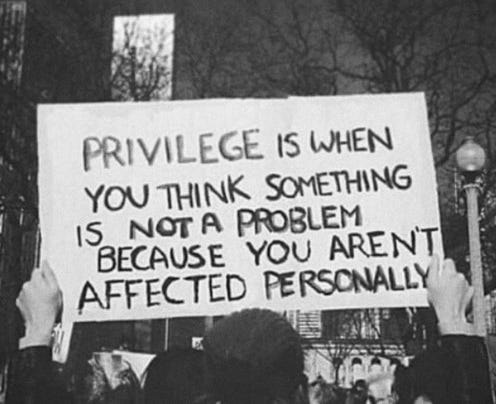
Because I know people like this. People I’ve known for years. People who have never done anything actively bad. They support their families. They show up. They are, on paper, good, good, good, good people. My instincts around people are usually reliable. They don’t scream danger. They don’t trigger alarm bells. So what is it that unsettles me?
It’s not cruelty.
It’s not malice.
It’s not even ignorance in the innocent sense.
It’s the choice.
The choice to not look.
Hi, I’m Drishti and I am privileged.
I grew up with education. With relative safety. With a family that, in many ways, cushioned me from the worst violences of the world. I can step out of my house on a Sunday night and expect to come back alive. That is not a personality trait. That is not merit. That is privilege.
But do you,
do you—recognise that you are a man?
Or a woman whose life has never brushed against the realities of women in marginalised communities?
Because let me say this slowly, without metaphors:
Every man has male privilege.
Even men from marginalised communities.
If you doubt that, go look at the women of those communities.
If you are a minority in a country, yes, you are underprivileged. But sit with the women who share your identity before you claim to speak for all of it. No—all men do not get to advocate for all men. No—all women do not get to advocate for all women. And no—no single human being gets to believe, comfortably and superficially, that they understand the whole world.
You live in a metropolitan city and tell me, gently, optimistically, that “things are getting better now.”
Are they?
Have you spoken to the girl who believes rape is not a tragedy but a certainty?
Who knows that her survival in her village depends on her silence?
Who understands that “justice” is not something meant for her body?
A minister of this country stands in Parliament and says—on record—that if rape is inevitable, a woman should enjoy it.
And still, you choose not to recognise your privilege.
I keep telling myself: He’s a nice person. He doesn’t know. He doesn’t realise.
But at what point does not-realising turn into not-wanting-to-know?
Are you still nice when you argue with me that feminism is outdated, that everything is equal now, that I should let it go?
Is it equal or are you simply insulated?
You ask me, almost amused, “What privilege?”
The privilege of riding your bike at 11 p.m. without calculating risk.
The privilege of existing freely and calling it normal.
The privilege of sitting at dinner and complaining that your wife needs to ask before buying shampoo and being tired of her purchases without hearing the absurdity echo back at you.
That is privilege.
So tell me
are you a nice person?
Or is the real question this:
do I lower my standards to keep believing you are?
Very introspective piece here. As a man of color, it’s interesting teetering this line of certain privileges while being denied certain others. I really loved this piece. Maturing and realizing that certain “normalities” for you are acts of desperation for others and recognition of that very thing is what helps the good in humanity move forward. Beautiful words but I must say, I ain’t riding no bike at 11 pm😂 I’m jk but totally get your point, very well said. Thank you for sharing
This made me uncomfortable in a useful way.
I’ve definitely mistaken being well-intentioned for being accountable.
The idea that privilege isn’t a personality trait but a condition you’re born into feels important to sit with, not argue against.
Thanks for naming that so clearly.